
APA vs MLA vs Chicago: Which Citation Style to Use
APA vs MLA vs Chicago: Which Citation Style to Use
Navigating the world of academic writing often feels like learning a new language. Just when you think you've mastered the art of formulating a strong thesis statement and conducting rigorous research, you're faced with the daunting task of formatting your citations. For many students, the mere mention of APA, MLA, or Chicago is enough to induce mild panic.
Why do we have so many different ways to simply say "I got this information from that book"? The truth is, different academic disciplines value different types of information. Understanding the philosophy behind these three primary citation styles will not only help you format your papers correctly but will also make you a more effective communicator in your chosen field.
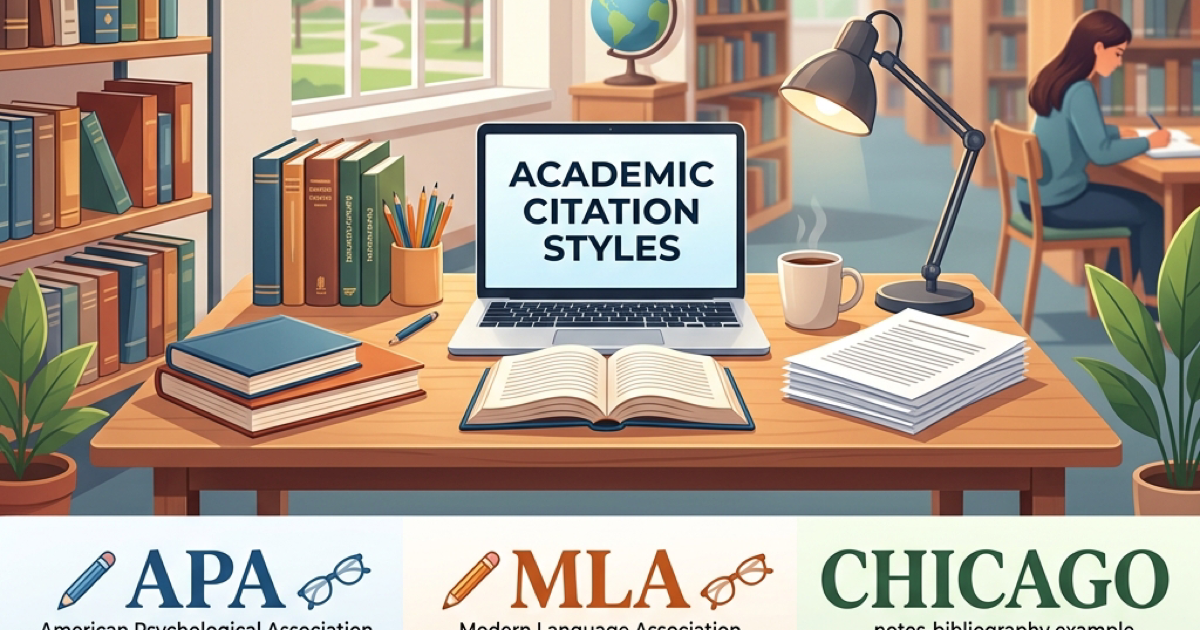
In this guide, we'll break down the core differences between APA, MLA, and Chicago styles, explain exactly when to use each one, and provide easy-to-follow examples.
1. APA Style (American Psychological Association)
Who Uses It?
APA is the undisputed king of the social sciences. If you are studying Psychology, Sociology, Education, Economics, Nursing, or Business, you will almost certainly be asked to write in APA format.
The Philosophy
The social sciences are heavily data-driven and time-sensitive. A behavioral study conducted in 1960 might be completely outdated compared to a similar study conducted in 2025. Therefore, APA places a massive emphasis on the Date of Publication.
How It Looks
APA uses an author-date system for in-text citations. When you reference a source in your text, you immediately provide the author's last name and the year it was published.
- In-Text Example: (Smith, 2024) or "According to Smith (2024), human behavior..."
- Reference List Example (Book): Smith, J. R. (2024). The psychology of modern learning. Academic Press.
Key APA Features
- Requires a title page and abstract.
- Uses headings to organize the paper clearly.
- In the "References" section at the end, only the first word of an article/book title (and any proper nouns) is capitalized.
Struggling to make sure your APA paper sounds properly academic? Check out the EssayMage Academic Proofreader to ensure your tone is as sharp as your citations.
2. MLA Style (Modern Language Association)
Who Uses It?
MLA is the default style for the Humanities—specifically subjects relating to literature, language, philosophy, and the arts. If you are taking an English Lit or Cultural Studies class, this is your go-to style.
The Philosophy
Unlike the social sciences, where a paper’s relevance often depends on how recent it is, the humanities focus on the author and the specific location of the text. Shakespeare said it best, and it doesn't matter if you quote a 1990 print or a 2020 print—what matters is who wrote it and exactly what page the quote is on so the reader can verify your literary analysis.
How It Looks
MLA uses an author-page system. You provide the author's last name and the exact page number of the quote or paraphrase. The year is left out of the in-text citation entirely.
- In-Text Example: (Johnson 45) or "Johnson notes that the imagery is profound (45)."
- Works Cited Example (Book): Johnson, Emily. The Art of Symbolism. University Press, 2023.
Key MLA Features
- No separate title page is required; instead, the student's name, instructor, course, and date are listed in the upper left corner of the first page.
- The reference page is called "Works Cited."
- All major words in titles are capitalized (Title Case).
3. Chicago Style (The Chicago Manual of Style)
Who Uses It?
Chicago is primarily the domain of History and some fine arts. It is widely considered the most complex and comprehensive of the big three.
The Philosophy
Historians deal with an massive variety of source materials: dusty archival letters, government documents, oral interviews, and obscure pamphlets. Trying to cram all that citation info into parentheses in the middle of a sentence becomes incredibly distracting. Chicago solves this by moving information out of the main text and into footnotes or endnotes. This allows the reader to focus purely on the historical narrative, glancing down only if they want to check the source.
How It Looks
Chicago actually has two systems, but the Notes and Bibliography system is the one most commonly used in history (the other being an Author-Date system similar to APA).
- In-Text Example: When writing your sentence, you simply insert a superscript number at the end.^1
- Footnote Example: 1. Thomas Jefferson, Notes on the State of Virginia (Richmond: J. W. Randolph, 1853), 42.
- Bibliography Example: Jefferson, Thomas. Notes on the State of Virginia. Richmond: J. W. Randolph, 1853.
Key Chicago Features
- Extensive use of footnotes at the bottom of the page.
- Requires a separate "Bibliography" at the end.
- Often requires a specific title page format depending on the instructor's preference.
Summary Cheat Sheet: Which One Should I Pick?
If your professor explicitly tells you which style to use (check the syllabus!), always follow their instructions. However, if you are given a choice or are confused about what the standard is for your major, use this quick reference:
| Field of Study | Default Style | Focus of the Style | In-Text Citation Method |
|---|---|---|---|
| English, Literature, Arts | MLA | The specific author and the exact page of the quote. | (Author Page) e.g., (Smith 12) |
| Psychology, Sociology, Business | APA | How recent the research is (the year of publication). | (Author, Year) e.g., (Smith, 2024) |
| History | Chicago | Keeping the narrative clean by burying complex sources below. | Footnotes^1 |
A Final Word on Avoiding Plagiarism
No matter which citation style you use, the most critical aspect of academic writing is making sure you actually credit your sources. Incorrectly formatting an APA comma might cost you a point on your rubric; forgetting the citation entirely will land you in front of the academic integrity board.
Before you submit your final draft to your professor, it is highly recommended to run it through a reliable checker to ensure no accidental overlap has occurred. The Originality Scanner by EssayMage doesn't just look for missing citations—it also screens for AI-generated text patterns, giving you total peace of mind before you hit "submit."
Mastering APA, MLA, and Chicago takes time, but by understanding the reason behind the rules, you'll be writing flawless bibliographies in no time.