
How to Check Your Essay for Plagiarism Before Submission (No University Login Required)
How to Check Your Essay for Plagiarism Before Submission (No University Login Required)
Many students do not worry about plagiarism only because of cheating. They worry because writing under pressure is messy. Notes get copied into drafts. Quotations lose their quotation marks. A paraphrase still sounds too close to the source. An old paragraph from another assignment gets reused without enough revision. By the time the paper is nearly done, the student wants one thing: a safe way to check the draft before submission.
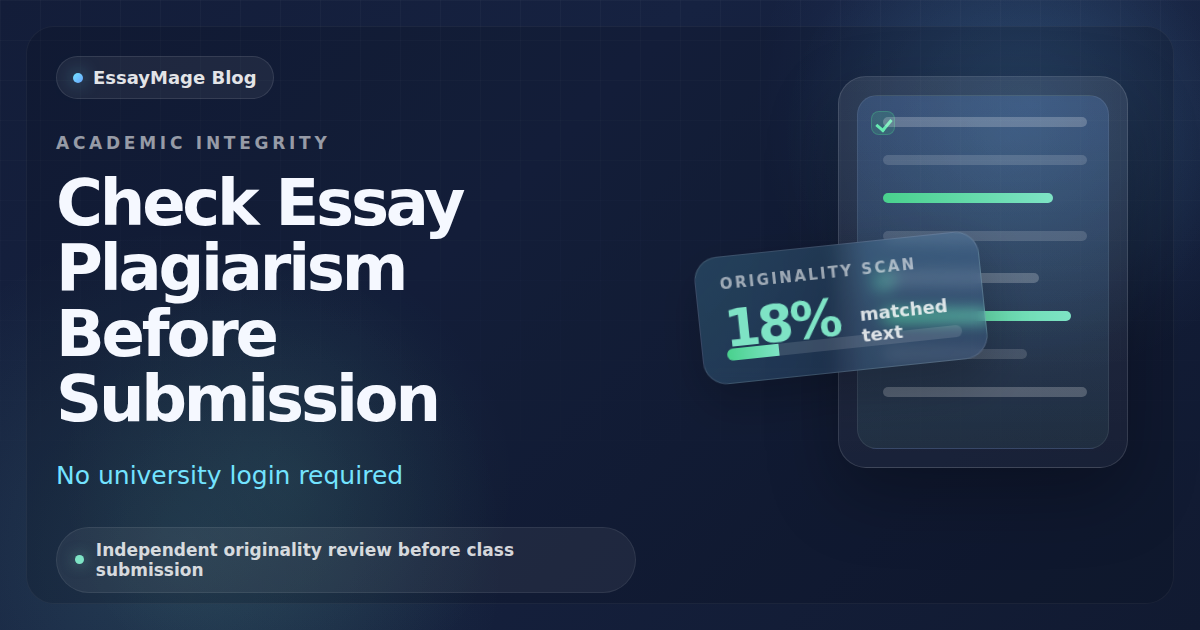
The problem is that many universities do not give students an independent similarity-checking portal. You may only see Turnitin or another detector inside a class assignment after the document is already being submitted for evaluation. That is why students keep searching for ways to check an essay for plagiarism without a university login.
The good news is that you do not need a campus portal to build a responsible review process. You do need a method. This guide explains how to check your essay before submission, what to review manually, what kind of checker actually helps, and how to revise flagged passages. For the originality stage, EssayMage's Originality Scanner is the most direct fit. After that, the Academic Proofreader helps you tighten wording and the Tone Refiner helps smooth awkward rewrites.
Step 1: Fix the obvious source-handling mistakes first
Before you run any plagiarism checker, clean the easy problems. Check whether your draft contains:
- copied notes pasted into body paragraphs
- missing quotation marks
- incomplete in-text citations
- bibliography entries that do not match the draft
- references left in the wrong citation style
A checker is more useful after this first cleanup, because the report becomes easier to interpret.
Step 2: Review your high-risk paragraphs manually
Not every paragraph carries the same level of risk. Focus first on sections that include:
- dense use of sources
- technical definitions
- close paraphrasing of a single article
- passages translated or rewritten from notes
- text reused from your own earlier work
Ask two practical questions: "Did this idea come from me or from a source?" and "Would I be able to point to the citation immediately?" If the answer is shaky, revise before you scan.
Step 3: Use an originality checker built for pre-submission review
This is the stage where many students waste time chasing a university login they do not actually have. Instead of trying to force access to an institutional workflow, use a tool that supports independent review.
EssayMage's Originality Scanner is especially useful here because it helps you inspect overlap before the draft reaches a professor. That matters for three reasons:
- you keep control of the revision process
- you can focus on passages that need real rewriting
- you can make decisions before the assignment counts
The point is not to chase a perfect score. The point is to identify where your draft may still be too dependent on existing wording.
Step 4: Interpret the report like a writer, not like a machine
A similarity score is not the same thing as plagiarism. A good review looks at context.
Harmless similarity may include:
- correctly quoted material
- standard terminology
- bibliography entries
- assignment-required wording
Risky similarity may include:
- paraphrases that keep the source's structure
- repeated source-heavy phrasing across one section
- uncited borrowed ideas
- overreliance on a single source
The report is useful only if it helps you decide what to revise.
Step 5: Revise flagged sections substantially
When a checker highlights a passage, do not only swap words. That usually creates stiff writing and does not solve the underlying issue.
A stronger revision process is:
- go back to the source
- confirm what idea you truly need from it
- close the source and explain the idea in your own structure
- add citation where required
- compare the new sentence against the old one
If the passage still sounds clumsy after revision, run it through the Tone Refiner to make the prose more natural while keeping the meaning intact.
Step 6: Proofread after the originality fixes
Originality edits often make a draft uneven. Sentences become longer, transitions break, and citation-heavy paragraphs start sounding mechanical. That is why proofreading should come after the similarity review.
EssayMage's Academic Proofreader is useful at this stage because it helps restore clarity, consistency, and academic tone after substantive revision.
What to avoid when you do not have a university login
Students under deadline pressure often choose risky shortcuts. Avoid these mistakes:
Uploading your essay to random "free" sites
Some sites explain almost nothing about privacy, retention, or source coverage. That is a poor trade if the draft matters.
Treating one number as a final verdict
A low score is not automatic safety, and a moderate score is not automatic guilt. Interpretation matters.
Revising only at the sentence level
Sometimes the real problem is paragraph structure, not a few words.
Forgetting self-plagiarism
Reusing your own old work without permission or citation can still cause academic trouble.
A practical no-login workflow for students
If you want a simple repeatable process, use this sequence:
- finish the draft
- clean obvious citation and quotation errors
- manually inspect high-risk paragraphs
- run an originality pre-check
- revise flagged passages deeply
- proofread the final version
This gives you a realistic way to reduce originality risk before submission, even without campus access.
Final thoughts
You do not need a university login to check your essay responsibly before submission. You need a private, practical workflow that helps you catch source-handling problems early and revise them properly.
Start with EssayMage's Originality Scanner to review overlap, then use the Academic Proofreader and Tone Refiner to polish the final draft. That process is more useful than waiting until the professor sees the paper first.