
How to Check if Your Essay is Plagiarized: A Complete Guide
How to Check if Your Essay is Plagiarized: A Complete Guide
Whether you are a high school student writing your first term paper or a graduate university student working on a complex dissertation, academic integrity should always be your top priority. In the modern educational landscape, producing original content is non-negotiable. However, with the vast amount of information available on the internet, unintentional plagiarism has become a highly common issue. If you are wondering how to check if your essay is plagiarized, you are not alone.
In this comprehensive guide, we will walk you through the various types of plagiarism, why it matters, and the step-by-step methods you can use to rigorously check essay plagiarism and ensure your work is 100% original before you hit "submit."
What Constitutes Plagiarism in Academic Writing?
Before diving into the tools and methods used to detect copied content, it is crucial to understand what plagiarism actually is. Plagiarism is not just copying and pasting an entire Wikipedia article into your Word document. It takes many forms, some of which are surprisingly subtle.
Direct Plagiarism
This is the most obvious form of plagiarism. It involves copying someone else's work word-for-word without using quotation marks or providing proper attribution. Even if you copy just a single sentence without citing the source, it qualifies as direct plagiarism.
Paraphrasing Plagiarism
Many students mistakenly believe that simply changing a few words in a sentence makes the idea their own. If you take someone else's idea and rewrite it using synonyms but fail to credit the original author, you are committing paraphrasing plagiarism. Proper paraphrasing requires you to fully digest the information and explain it in your own unique voice—and you must still provide a citation for the idea.
Self-Plagiarism
Can you plagiarize yourself? Yes, absolutely. Self-plagiarism occurs when you reuse portions of your own previously submitted work without permission from your current instructor. Academic institutions expect all assignments to represent new, original effort.
Accidental Plagiarism
This is the most common pitfall for honest students. Accidental plagiarism happens when you forget to include a citation, misattribute a quote, or format your references incorrectly. Regardless of your intentions, accidental plagiarism carries the same harsh penalties as deliberate cheating.
Why You Need to Check Your Essay for Plagiarism
You might be completely confident that you wrote every word of your essay from scratch. So, why should you still use a plagiarism checker?
- Catching Unintentional Mistakes: When juggling dozens of tabs, PDFs, and library books, it is easy to accidentally paste a quote into your draft and forget to add the citation or quotation marks.
- Protecting Your Academic Record: The consequences of academic dishonesty are severe. They range from failing the assignment and failing the course to academic probation or outright expulsion.
- Enhancing Your Writing: Running your work through a checker forces you to review your research and ensures that your own voice shines through, rather than relying too heavily on external sources.
Step-by-Step Guide: How to Check Your Essay
Now that you understand the stakes, here is a practical, step-by-step process to ensure your essay is completely original.
Step 1: Perform a Manual Review and Citation Check
Before relying on software, do a manual sweep of your paper.
- Read through your essay and highlight every single claim, statistic, or idea that is not "common knowledge."
- Verify that every highlighted section has a corresponding in-text citation.
- Ensure that your bibliography or reference list matches your in-text citations exactly.
- Check that all direct quotes are enclosed in quotation marks.
Step 2: Use a Reliable Plagiarism Checker
Manual checking is essential, but it is not foolproof. The human eye easily misses things, which is why a robust software solution is necessary. This is where a dedicated plagiarism checker comes in.
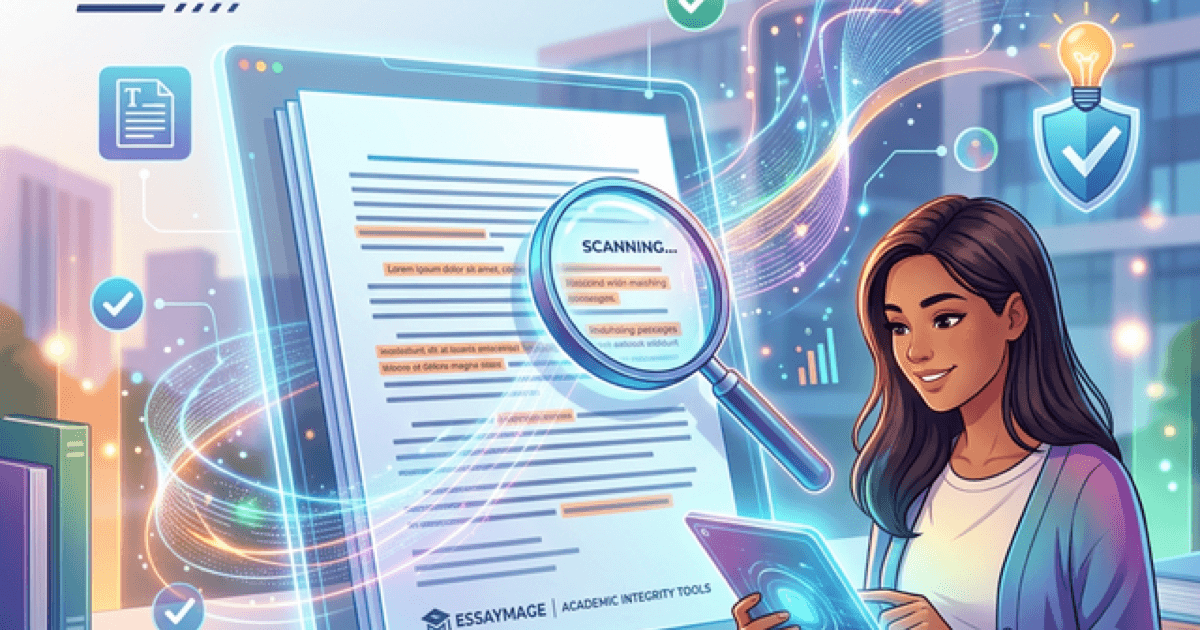
Instead of relying on free, outdated tools that only check a small database, you need a scanner that checks against billions of web pages, journals, and publications. We highly recommend using EssayMage's Originality Scanner. It is designed specifically for academic writing, ensuring that every sentence is cross-referenced comprehensively against a massive global database.
Step 3: Analyze the Similarity Report
Once you run your essay through the checker, you will receive a similarity or originality report. It is important to know how to read this report.
- A 0% similarity score is rare, especially if your paper includes a bibliography or common academic phrases.
- Typically, a score below 10-15% is acceptable (though you should always check your specific institution's guidelines).
- Look closely at the highlighted sections. If the tool highlights a direct quote that is properly cited, you can safely ignore it. However, if it highlights a paragraph of your own text, you need to revisit that section immediately.
What to Look for in a Plagiarism Checker
Not all check essay plagiarism tools are created equal. When choosing a tool to check your essay, look for these critical features:
- Database Size: The tool is only as good as the content it checks against. Ensure it scans modern web pages, academic journals, and books.
- AI Detection Capabilities: In today's digital age, many institutions use tools to detect whether an essay was written by artificial intelligence like ChatGPT. Look for a checker that includes AI detection features to ensure your human-written work isn't falsely flagged.
- Data Privacy: Never upload your essay to a sketchy, free site that might add your paper to its database and sell it. Ensure the platform respects your intellectual property.
How to Fix Plagiarized Content Before Submission
If your plagiarism score comes back higher than you expected, do not panic. You still have time to fix it before submission.
- Add Missing Citations: Go back to the flagged sections and add the appropriate APA, MLA, or Chicago citations.
- Rewrite and Refine: If you relied too heavily on a source, rewrite the section in your own words. If you struggle with maintaining an academic tone while rewriting, consider using a tool like EssayMage's Tone Refiner to help you elevate your language and maintain your unique voice while properly synthesizing the information.
- Final Proofreading: After making major changes to fix plagiarism, your essay's flow might be disrupted. Always do a final read-through to ensure the grammar and structure remain intact. Running your final draft through a professional Academic Proofreader can catch any lingering typos and grammatical inconsistencies introduced during the editing process.
EssayMage: Your All-in-One Academic Solution
Ensuring your essay is free from plagiarism does not have to be a stressful, anxiety-inducing process. By blending careful manual review with powerful, modern technology, you can submit your papers with absolute confidence.
If you are looking for an accurate, secure, and comprehensive way to check essay plagiarism, EssayMage offers a state-of-the-art Originality Scanner designed specifically with students and researchers in mind. Not only does it protect you from accidental academic misconduct, but when paired with our tone refinement and proofreading services, it empowers you to submit the best possible version of your work.
Start adopting these best practices today, and make plagiarism concerns a thing of the past!