

How to Respond to Peer Review Comments: A Complete Guide
How to Respond to Peer Review Comments: A Complete Guide
Receiving a "Revise and Resubmit" (R&R) decision from a journal can be a rollercoaster of emotions. On one hand, your manuscript hasn't been rejected, which is a significant win. On the other hand, you are now faced with a list of criticisms, suggestions, and sometimes contradictory demands from anonymous reviewers.
The way you respond to these comments is just as important as the quality of the research itself. A professional, organized, and respectful response can smooth the path to final acceptance, while a defensive or dismissive response can lead to a second rejection.
This guide provides a comprehensive strategy for responding to peer review comments, ensuring you address every critique while maintaining the integrity of your work. If you find yourself struggling to strike the right professional balance, EssayMage's Tone Refiner can help you polish your response letter to be both persuasive and respectful.
The Golden Rules of Responding to Reviewers
Before you dive into the specific comments, keep these three psychological principles in mind:
- Be Polite and Respectful: Even if a reviewer is blunt or seems to have missed the point, your response must remain professional. Thank them for their time and careful reading.
- Address Every Single Point: Do not ignore a comment just because it’s difficult or you disagree with it. If a reviewer raised it, it requires a response.
- Be Clear and Organized: The editor is busy. Make it as easy as possible for them to see exactly how you have changed the manuscript based on the feedback.
Step 1: Process Your Emotions First
When you first open the decision letter, it’s natural to feel defensive. You might think, "Reviewer 2 didn't even read the paper!" or "Their suggestion would break the whole study!"
Do not respond immediately. Read the comments once, then put them away for 24 to 48 hours. When you return, you will likely see that many of the comments are actually helpful suggestions for improving the clarity of your work.
Step 2: Create a Response Matrix
The most effective way to manage a revision is to create a table or a point-by-point document.
- Column 1: Copy the original reviewer comment exactly.
- Column 2: Your response (e.g., "We agree with the reviewer and have added the requested data...").
- Column 3: The specific changes made, including line numbers in the revised manuscript.
This structure ensures that nothing is forgotten and demonstrates to the editor that you have taken the process seriously.
Step 3: Categorize the Feedback
Not all comments require the same level of work. Group them into three categories:
1. Minor Corrections (The "Easy Wins")
These are typos, formatting issues, or requests for more citations. Fix these immediately. They show reviewers that you are attentive to detail.
2. Clarity and Explanation Requests
If a reviewer says they don't understand your method, it means your writing wasn't clear enough. Even if you think you explained it, avoid saying "We already said this." Instead, say "We have clarified the description of the methodology on page 5 to ensure better understanding."
3. Major Scientific or Conceptual Critiques
These are the hardest to handle. They may require new experiments, new data analysis, or a significant reframing of your argument. Address these with logic and evidence.
Step 4: How to Disagree with a Reviewer
You do not have to agree with everything a reviewer says. You are the expert on your own work. However, if you choose not to change something, you must provide a compelling, evidence-based reason why.
The wrong way to disagree:
"The reviewer is wrong. Our method is fine."
The right way to disagree:
"We appreciate the reviewer's suggestion to include a longitudinal analysis. However, given the current resource constraints and the specific focus on acute outcomes defined in our original proposal, we believe a cross-sectional approach remains the most appropriate for this research question. We have added a section to the limitations (page 12) discussing this point."
By being respectful and providing a rationale, you show that you considered the feedback but made a deliberate scientific choice. Use our Academic Proofreader to ensure your reasoning is articulated clearly and professionally.
Step 5: Draft the Response Letter
Your response letter (also called a "rebuttal letter") is a formal document addressed to the editor. It should follow this structure:
- Opening: Thank the editor and reviewers. State the title and manuscript number.
- Overview: Summarize the major changes you made. This gives the editor a "big picture" view of the improvements.
- Point-by-Point Response: This is the heart of the letter. Use the matrix you created in Step 2.
- Closing: Reiterate your hope that the revised manuscript is now suitable for publication.
Common Challenges and Solutions
Contradictory Reviewer Advice
Sometimes Reviewer 1 wants more detail, while Reviewer 2 wants the paper shorter. In this case, use the editor as your guide. If the editor hasn't specified which one to follow, choose the path that makes the paper scientifically stronger and explain your choice in the response letter.
The "Request for more experiments"
If you cannot perform the requested experiments (due to time, money, or ethics), explain why and try to address the underlying concern by clarifying your interpretation of the existing data or adding it as a future research direction.
Reviewer 2 (The Stubborn One)
We’ve all had the reviewer who seems to have an axe to grind. Keep your cool. Respond to their logic, not their tone. If they are truly unreasonable, the editor will usually recognize it—but only if you remain the "professional" in the room.
Final Checklist for Revision
Before resubmitting, ensure you have:
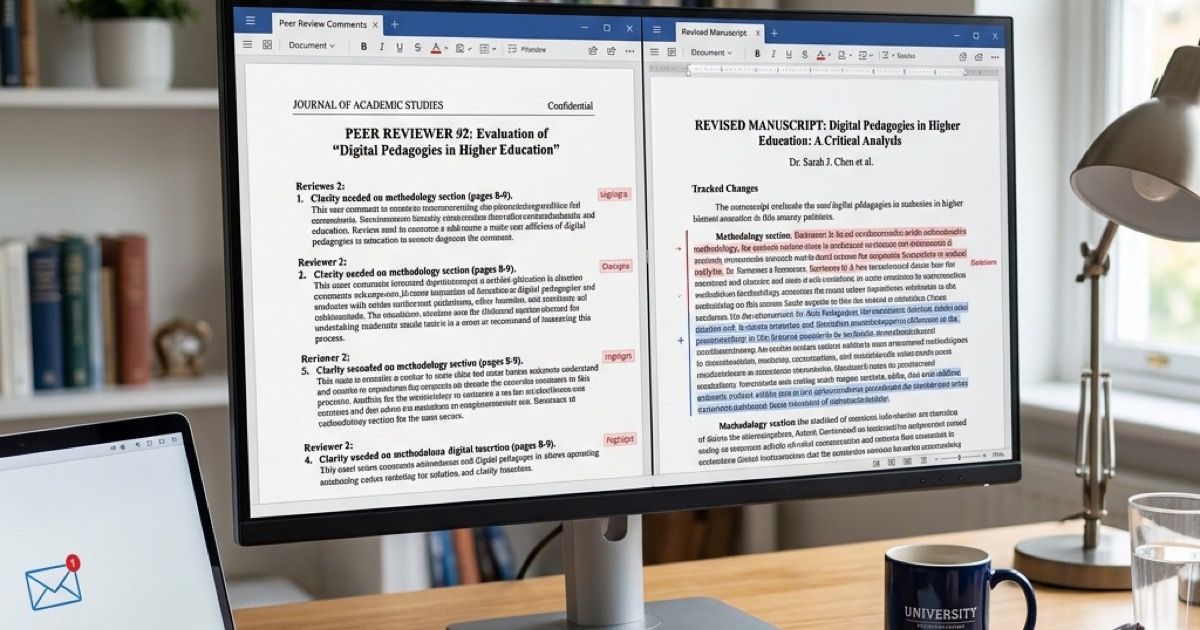
- Highlighted changes in the revised manuscript (usually using "Track Changes").
- Double-checked that all line numbers in your response letter match the new draft.
- Addressed every single comment, even small ones.
- Used a professional and grateful tone throughout.
- Proofread the response letter carefully with the Academic Proofreader.
Conclusion
Responding to peer review is an essential skill in an academic career. It is the final "test" of your scholarship. By approaching it as a collaborative process rather than a battle, you not only increase your chances of publication but often end up with a significantly better paper.
Remember, the goal of the peer review process is to improve the quality of published research. Even the most frustrating comments can be a catalyst for creating a more robust, clear, and impactful manuscript. With patience, organization, and a little help from tools like EssayMage's Tone Refiner, you can navigate the revision process with confidence and reach the finish line of publication.