

How to Write a Strong Thesis Statement: Formula, Examples, and Common Mistakes
How to Write a Strong Thesis Statement: Formula, Examples, and Common Mistakes
A weak thesis statement creates problems for the entire paper. If the main claim is vague, too broad, or too obvious, the introduction feels flat, the body paragraphs lose direction, and the conclusion has nothing precise to prove. That is why students often feel that an essay is "messy" even when the research is fine. The real problem starts much earlier: the paper never had a strong controlling idea.
This guide explains how to write a strong thesis statement in a practical way. You will see what a thesis statement actually does, how to build one step by step, what common mistakes to avoid, and how to revise a weak draft into a focused academic claim. If you are still shaping the whole paper, our guide on how to write a research paper gives the wider workflow. Once your draft exists, EssayMage's Academic Proofreader can help tighten clarity, and the Tone Refiner is useful when a thesis sounds stiff or generic after multiple revisions.
What a Thesis Statement Actually Does
A thesis statement is not just a topic. It is the sentence that tells the reader:
- what you are arguing
- how narrowly the paper is focused
- what direction the analysis will take
In most academic essays, the thesis appears near the end of the introduction. By that point, the reader should understand the question, the context, and the paper's central position.
A good thesis helps three audiences at once:
- your reader, because it sets expectations
- your instructor, because it shows that you have a clear argument
- you, because it makes paragraph planning much easier
If a paragraph does not support the thesis, it probably does not belong in the paper.
The Three-Part Formula for a Strong Thesis
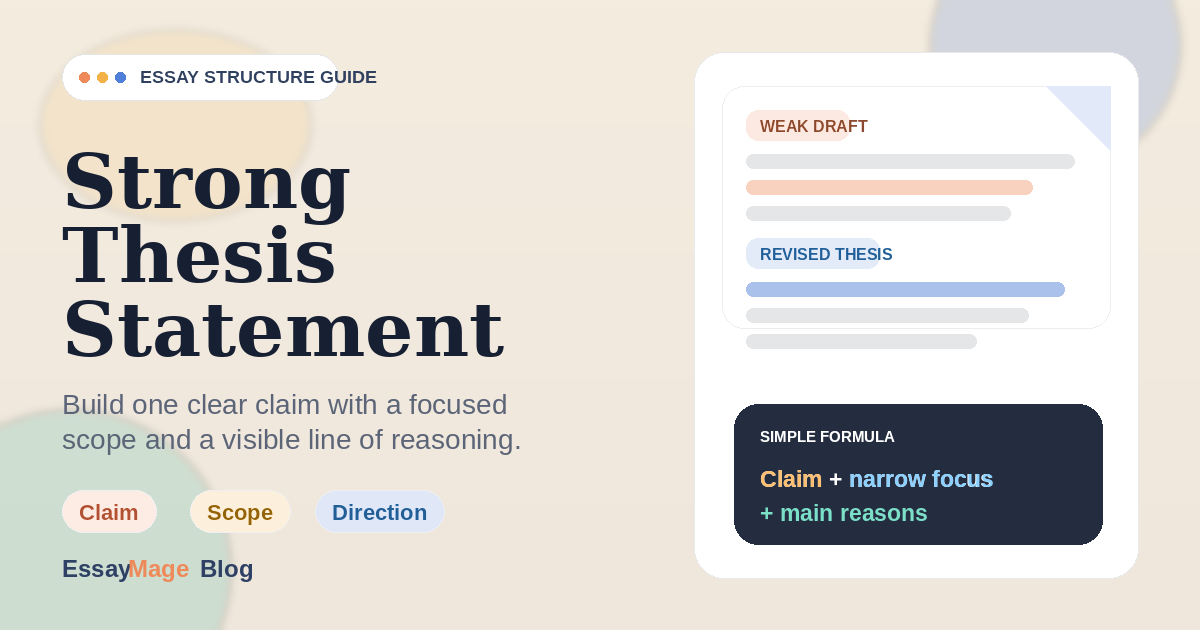
Most strong thesis statements contain three parts:
- claim: your main answer or position
- scope: the specific aspect you are discussing
- direction: the main reasons, pattern, or analytical path
Here is a simple formula:
Although / Because / While X, Y because A, B, and C.
You do not need to copy that exact wording, but the structure helps. It forces you to move beyond a broad topic and into a real argument.
For example:
- Weak: "Social media affects students."
- Better: "Heavy social media use reduces students' concentration during study sessions because it fragments attention, normalizes constant interruption, and weakens deep reading habits."
The second version does real work. It gives the paper a claim, a focus, and three body-paragraph directions.
How to Build a Thesis Statement Step by Step
1. Start with the assignment question
Before writing the thesis, answer the prompt in plain language. If the assignment asks whether remote learning improves educational access, write your rough answer first:
"It improves access for some students, but it also creates participation and support problems."
That sentence is still informal, but it gives you material to refine.
2. Narrow the scope
A strong thesis rarely tries to cover everything. Ask:
- what exact population am I discussing?
- what time period, text, or case study matters here?
- what type of effect or pattern am I analyzing?
Compare these two versions:
- Too broad: "Climate change policy is important."
- Focused: "City-level heat adaptation policy is most effective when it combines tree-cover expansion with tenant protections for high-risk neighborhoods."
The second version is much easier to support with evidence.
3. Add your reasoning
Your thesis should hint at why your position is persuasive. Those reasons may become body paragraphs.
For example:
- Basic: "University attendance policies should be more flexible."
- Stronger: "University attendance policies should be more flexible for commuter students because rigid participation rules ignore transportation delays, caregiving duties, and uneven access to campus resources."
Now the paper has a map.
4. Test whether it is arguable
A thesis should not be a fact that nobody would dispute. It should be a position that needs support.
- Too obvious: "Exercise is good for your health."
- Arguable: "Short daily exercise programs are more sustainable for college students than long weekly workouts because they fit academic schedules, reduce avoidance, and build routine faster."
If nobody needs convincing, you do not have a thesis yet.
Before-and-After Thesis Examples
Here are a few quick examples from common assignment types.
Analytical essay
- Weak: "The novel shows that power is dangerous."
- Strong: "In Animal Farm, Orwell presents political power as self-corrupting because revolutionary language becomes propaganda, fear replaces solidarity, and leaders redesign truth to protect privilege."
Compare-and-contrast essay
- Weak: "Online classes and in-person classes are different."
- Strong: "Online classes offer greater scheduling flexibility, but in-person classes produce stronger discussion and accountability for first-year students."
Research paper
- Weak: "AI tools are changing education."
- Strong: "AI writing tools are reshaping higher education by accelerating drafting, complicating authorship expectations, and forcing instructors to assess process as well as final output."
Each strong version gives you a clear structure for the rest of the paper.
Common Thesis Statement Mistakes
Students usually struggle with thesis statements for one of four reasons.
Mistake 1: Writing a topic instead of an argument
"This paper is about social inequality" tells the reader almost nothing. A thesis must take a position on that topic.
Mistake 2: Making the claim too broad
If the thesis tries to explain an entire field, the paper becomes shallow. Limit the claim until it matches the word count and evidence you actually have.
Mistake 3: Listing points without a central claim
Some students write introductions that say, "This essay will discuss causes, effects, and solutions." That is a plan, not an argument. The thesis still needs a controlling idea.
Mistake 4: Promising more than the paper can prove
A bold claim is not automatically a strong claim. If your evidence only supports a limited argument, write the limited argument. Precision is more convincing than exaggeration.
A Quick Revision Checklist
Before you lock in your thesis statement, ask these questions:
- Does it answer the actual assignment prompt?
- Is the claim specific enough for the paper length?
- Can a reasonable reader disagree with it?
- Does it suggest the paper's main supporting points?
- Does every body paragraph clearly connect back to it?
- Is the wording direct instead of padded with vague phrases?
- Could I support it with the evidence I already have?
If several answers are "no," revise the thesis before revising the body paragraphs. Fixing the controlling sentence first usually saves time.
A Better Workflow for Students
The best thesis statements usually come from revision, not from the first five minutes of drafting. A practical workflow looks like this:
- answer the prompt in plain language
- narrow the subject to a manageable scope
- identify two or three main reasons
- draft the body paragraphs
- return to the thesis and sharpen the wording
This final step matters. After the body is drafted, you know what the paper actually proves. That makes it much easier to replace generic wording with precise argument language.
When your thesis is clear but the sentence still feels awkward, EssayMage's Tone Refiner can help smooth the wording. When the introduction and body no longer align after revision, the Academic Proofreader can help restore flow and clarity. If your paper relies heavily on source material, the Originality Scanner is useful before submission to make sure your paraphrasing stays distinct from the source.
Final Thought
A strong thesis statement does not need to sound dramatic. It needs to be clear, focused, arguable, and genuinely useful for the paper that follows. When students struggle with structure, evidence, or paragraph unity, the thesis is often the best place to diagnose the problem.
If you want a simple rule to remember, use this one: make one specific claim that your paper can actually prove. That is the foundation of a better essay. Then revise the sentence until it gives both you and your reader a clear direction from the first paragraph onward.