

Understanding Turnitin: A Student's Guide to Similarity Reports and Academic Integrity
Understanding Turnitin: A Student's Guide to Similarity Reports and Academic Integrity
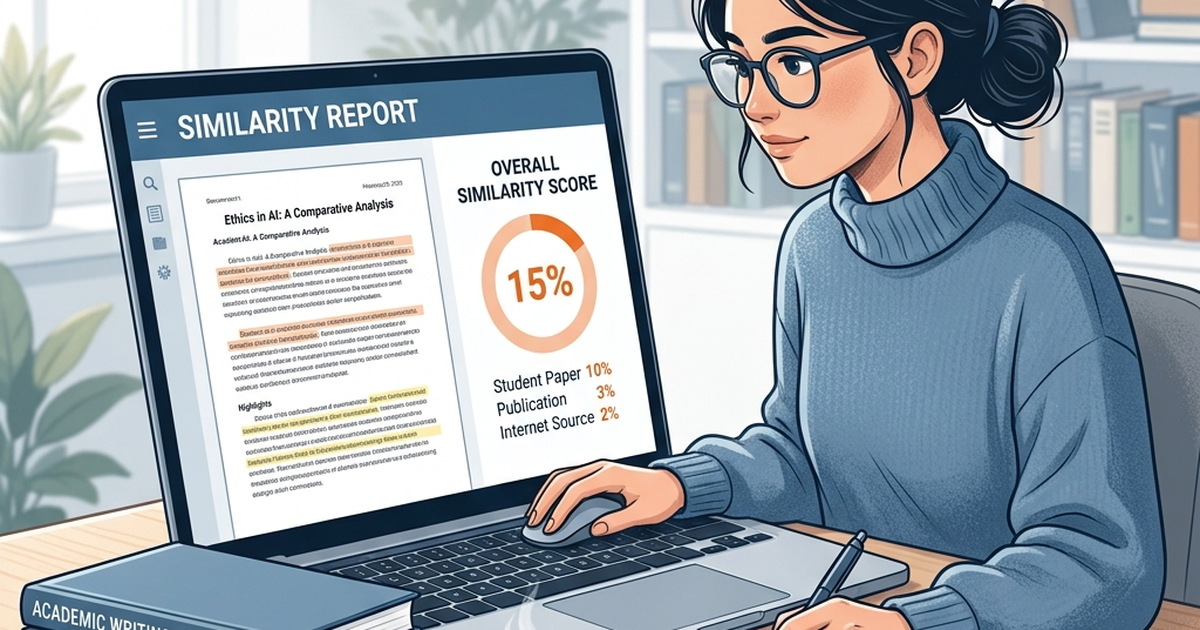
For many students, the word "Turnitin" brings a sense of anxiety. You spend weeks researching and writing, only to see a colored percentage box appearing next to your submission. What does a 15% score mean? Is 25% too high? Does a 0% score mean your paper is perfect?
Understanding how Turnitin works is essential for navigating modern academia. It is not just about "catching cheaters"; it is a tool designed to help you cite correctly and maintain academic integrity. In this guide, we will de-mystify the Turnitin Similarity Report and explain how you can use it to improve your writing.
What Turnitin Actually Does (and Doesn’t Do)
A common misconception is that Turnitin is a "plagiarism detector." In reality, Turnitin is a similarity checker.
How it works
Turnitin compares your submitted paper against a massive database of web pages, journals, books, and previously submitted student papers. When it finds a string of words that matches another source, it highlights it.
The Human Element
Turnitin does not "know" if you plagiarized. It only knows that your text is similar to something else. A high score might simply mean you have many correctly cited direct quotations. A low score could still hide plagiarism if you have poorly paraphrased ideas without attribution. It is always up to your professor to look at the report and make a human judgment.
Decoding the Similarity Score
The Similarity Score is the percentage of your paper that matches sources in Turnitin's database. Here is what the different colors generally represent:
- Blue: No matching text (0%)
- Green: One word to 24% matching text
- Yellow: 25-49% matching text
- Orange: 50-74% matching text
- Red: 75-100% matching text
Is there a "safe" percentage?
Most universities do not have a hard "cutoff" for what is acceptable. A 15-20% score is often normal for papers with a lot of references. However, if that 15% comes from one single block of un-cited text, it’s a problem. Conversely, if 40% is highlighted but it’s all common phrases or properly cited quotes, it might be perfectly fine.
Common Reasons for a High Score
If you see a high percentage, don't panic. Check the report to see what is being highlighted.
- Direct Quotations: If you use many long quotes, your score will go up. Even if cited correctly, Turnitin will highlight them unless the professor excludes "quotes" from the filter.
- Bibliographies and Citations: Lists of references often match other papers. Most professors exclude the bibliography from the final score.
- Common Phrases: In specific fields, certain phrases (e.g., "The results of this study suggest that...") are used so often that they trigger a match.
- Poor Paraphrasing: If you changed just a few words from a source but kept the original structure, Turnitin will catch it. This is known as "patchwriting."
How to Lower Your Similarity Score Honestly
The goal isn't to "trick" the system; it’s to improve your academic scholarship.
Master the Art of Paraphrasing
Instead of swapping synonyms, try reading a passage, closing the book, and explaining the idea out loud. Then, write down your explanation. This ensures the sentence structure is uniquely yours. To ensure your paraphrasing is distinct enough, you can use our Tone Refiner to help reshape your sentences into a original academic voice.
Use Quotes Sparingly
Only quote directly when the original wording is unique, powerful, or essential for analysis. For everything else, paraphrase and cite.
Check Your Work Before Final Submission
Many students feel more comfortable checking their work independently before submitting it to their university's official portal. Using an external Originality Scanner allows you to see potential matches early and fix citation errors without the fear of your draft being permanently saved to a central institutional database.
Using Turnitin as a Learning Tool
Think of the Similarity Report as a map of your research.
- If your report shows a sea of highlights, you might be relying too much on other people's words and not enough on your own analysis.
- If you see highlights that you forgot to cite, it’s a chance to fix them before it becomes a disciplinary issue.
Conclusion
Turnitin is a powerful tool in the academic world, but it is not something to be feared. By understanding that it measures similarity rather than plagiarism, you can use its feedback to become a more rigorous and careful writer.
Always aim for transparency in your citations, and don't hesitate to use supportive tools. Whether you are using an Academic Proofreader to polish your final draft or a similarity checker to verify your sources, the goal remains the same: submitting work that is uniquely and authentically yours.