

Cómo escribir un párrafo de conclusión sólido para un ensayo
Cómo escribir un párrafo de conclusión sólido para un ensayo
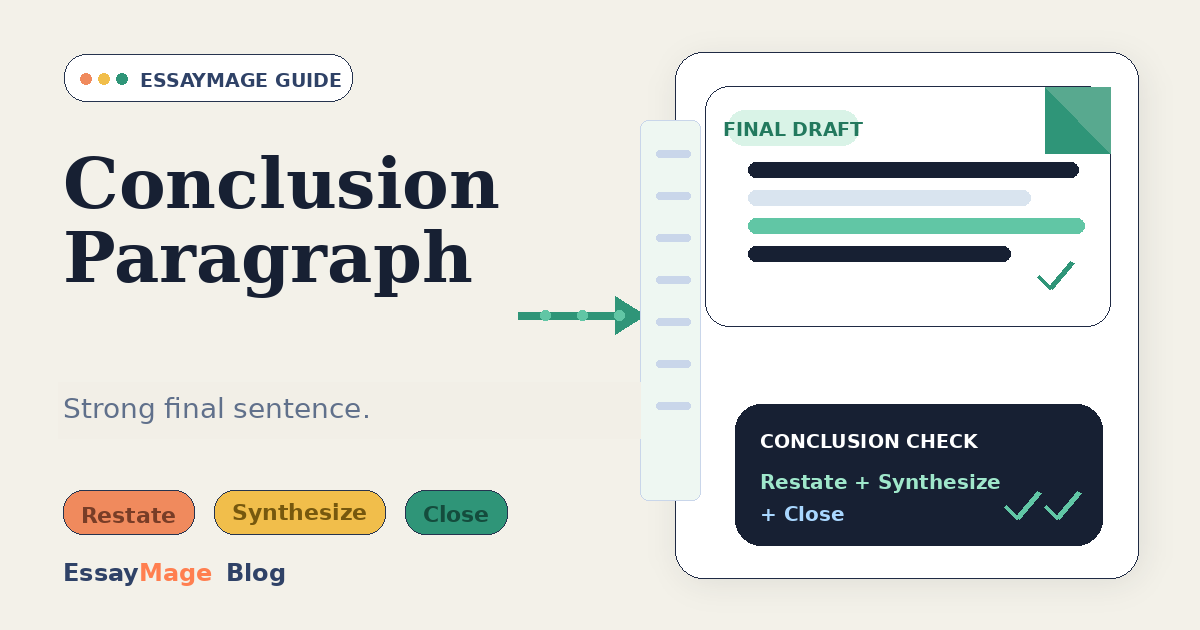
Un párrafo de conclusión no debe repetir la introducción. Debe mostrar qué puede entender ahora el lector gracias a tus pruebas. Esta guía divide el cierre en pasos reutilizables: volver a la tesis, sintetizar ideas, explicar la importancia y cerrar con una frase final clara.
Antes de entregar, EssayMage puede ayudarte a pulir el lenguaje con Academic Proofreader, ajustar el estilo con Tone Refiner y revisar la originalidad con Originality Scanner.
Por qué importa esta habilidad
Academic assignments reward decisions that are visible to the reader. When your research notes, paragraph structure, and final wording are deliberate, your work feels more credible and easier to assess. The goal is not to sound complicated; the goal is to make the logic of your thinking easy to follow from the first sentence to the final line.
This topic also protects you from last-minute revision problems. Students often lose time because they collect too many sources, repeat the introduction in the conclusion, or paste paraphrases that are too close to the original. A clear method reduces those risks and gives you a repeatable process for future papers.
Método paso a paso
1. Know what a conclusion is supposed to do
Start with the purpose of the assignment and write one sentence that names the job this part of the paper must do. Then compare that sentence with your draft. If the draft contains extra background, unsupported claims, or language that does not move the argument forward, revise before adding more material. This small pause keeps the section focused and prevents accidental repetition.
Use evidence carefully. Introduce the source or point, explain why it matters, and connect it back to the question your paper is answering. If a sentence could appear in any essay on the topic, make it more specific by naming the concept, method, example, or consequence that belongs to your assignment.
2. Restate the thesis without copying it
Start with the purpose of the assignment and write one sentence that names the job this part of the paper must do. Then compare that sentence with your draft. If the draft contains extra background, unsupported claims, or language that does not move the argument forward, revise before adding more material. This small pause keeps the section focused and prevents accidental repetition.
Use evidence carefully. Introduce the source or point, explain why it matters, and connect it back to the question your paper is answering. If a sentence could appear in any essay on the topic, make it more specific by naming the concept, method, example, or consequence that belongs to your assignment.
3. Synthesize instead of summarizing mechanically
Start with the purpose of the assignment and write one sentence that names the job this part of the paper must do. Then compare that sentence with your draft. If the draft contains extra background, unsupported claims, or language that does not move the argument forward, revise before adding more material. This small pause keeps the section focused and prevents accidental repetition.
Use evidence carefully. Introduce the source or point, explain why it matters, and connect it back to the question your paper is answering. If a sentence could appear in any essay on the topic, make it more specific by naming the concept, method, example, or consequence that belongs to your assignment.
4. Explain the significance of your answer
Start with the purpose of the assignment and write one sentence that names the job this part of the paper must do. Then compare that sentence with your draft. If the draft contains extra background, unsupported claims, or language that does not move the argument forward, revise before adding more material. This small pause keeps the section focused and prevents accidental repetition.
Use evidence carefully. Introduce the source or point, explain why it matters, and connect it back to the question your paper is answering. If a sentence could appear in any essay on the topic, make it more specific by naming the concept, method, example, or consequence that belongs to your assignment.
5. Avoid common weak ending patterns
Start with the purpose of the assignment and write one sentence that names the job this part of the paper must do. Then compare that sentence with your draft. If the draft contains extra background, unsupported claims, or language that does not move the argument forward, revise before adding more material. This small pause keeps the section focused and prevents accidental repetition.
Use evidence carefully. Introduce the source or point, explain why it matters, and connect it back to the question your paper is answering. If a sentence could appear in any essay on the topic, make it more specific by naming the concept, method, example, or consequence that belongs to your assignment.
6. Use a practical paragraph formula
Start with the purpose of the assignment and write one sentence that names the job this part of the paper must do. Then compare that sentence with your draft. If the draft contains extra background, unsupported claims, or language that does not move the argument forward, revise before adding more material. This small pause keeps the section focused and prevents accidental repetition.
Use evidence carefully. Introduce the source or point, explain why it matters, and connect it back to the question your paper is answering. If a sentence could appear in any essay on the topic, make it more specific by naming the concept, method, example, or consequence that belongs to your assignment.
7. Polish the final sentence and tone
Start with the purpose of the assignment and write one sentence that names the job this part of the paper must do. Then compare that sentence with your draft. If the draft contains extra background, unsupported claims, or language that does not move the argument forward, revise before adding more material. This small pause keeps the section focused and prevents accidental repetition.
Use evidence carefully. Introduce the source or point, explain why it matters, and connect it back to the question your paper is answering. If a sentence could appear in any essay on the topic, make it more specific by naming the concept, method, example, or consequence that belongs to your assignment.
Errores comunes que debes evitar
- Treating a required academic format as a decoration rather than part of the argument.
- Using long quotations or copied phrasing when a concise paraphrase would show stronger understanding.
- Adding a dramatic final claim that the paper has not actually proven.
- Forgetting to check whether every citation, paragraph, and transition supports the same central purpose.
- Revising only grammar while leaving structure and source use unchanged.
Lista rápida antes de entregar
- Does the title match the real focus of the draft?
- Does every paragraph have a clear function?
- Are sources introduced, interpreted, and cited consistently?
- Have you removed repeated wording from the introduction and conclusion?
- Have you checked tone, grammar, and originality before submission?
Antes de entregar, EssayMage puede ayudarte a pulir el lenguaje con Academic Proofreader, ajustar el estilo con Tone Refiner y revisar la originalidad con Originality Scanner.