

エッセイの強い結論段落を書く方法
エッセイの強い結論段落を書く方法
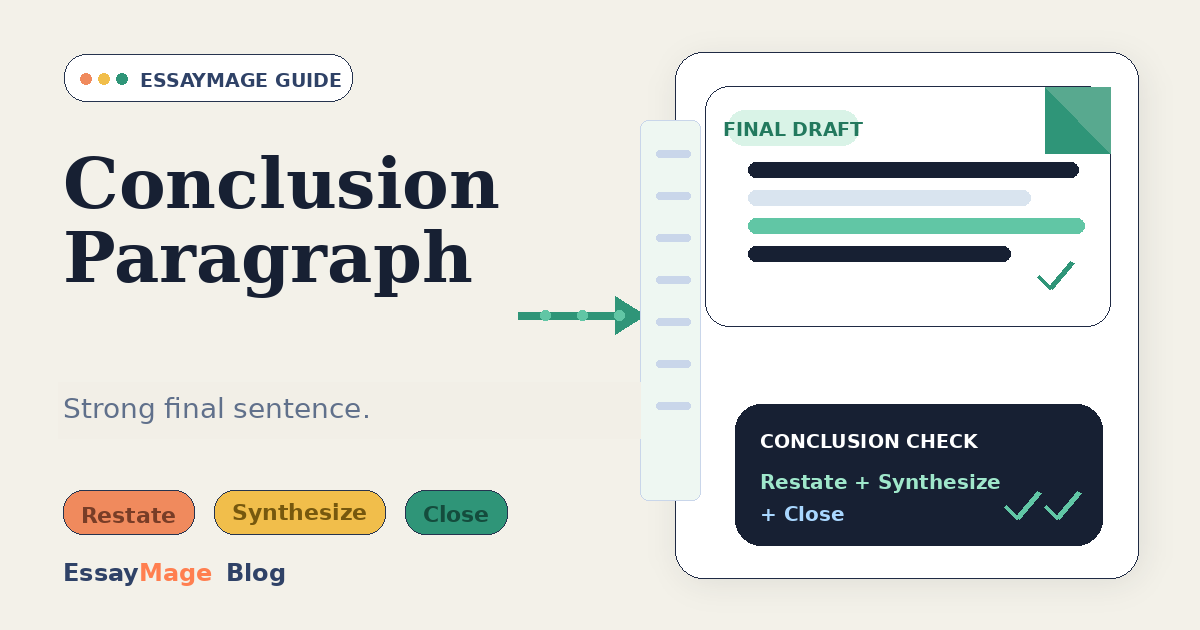
結論段落は導入を繰り返すだけでは不十分です。根拠によって読者が何を理解できるようになったかを示す必要があります。このガイドでは、主張に戻る、要点を統合する、意義を説明する、曖昧で大げさでない締めの一文を書く、という再現可能な手順に分けて説明します。
提出前には、EssayMage の Academic Proofreader で表現を整え、Tone Refiner で文体を調整し、Originality Scanner で独自性を確認できます。
このスキルが重要な理由
Academic assignments reward decisions that are visible to the reader. When your research notes, paragraph structure, and final wording are deliberate, your work feels more credible and easier to assess. The goal is not to sound complicated; the goal is to make the logic of your thinking easy to follow from the first sentence to the final line.
This topic also protects you from last-minute revision problems. Students often lose time because they collect too many sources, repeat the introduction in the conclusion, or paste paraphrases that are too close to the original. A clear method reduces those risks and gives you a repeatable process for future papers.
段階的な方法
1. Know what a conclusion is supposed to do
Start with the purpose of the assignment and write one sentence that names the job this part of the paper must do. Then compare that sentence with your draft. If the draft contains extra background, unsupported claims, or language that does not move the argument forward, revise before adding more material. This small pause keeps the section focused and prevents accidental repetition.
Use evidence carefully. Introduce the source or point, explain why it matters, and connect it back to the question your paper is answering. If a sentence could appear in any essay on the topic, make it more specific by naming the concept, method, example, or consequence that belongs to your assignment.
2. Restate the thesis without copying it
Start with the purpose of the assignment and write one sentence that names the job this part of the paper must do. Then compare that sentence with your draft. If the draft contains extra background, unsupported claims, or language that does not move the argument forward, revise before adding more material. This small pause keeps the section focused and prevents accidental repetition.
Use evidence carefully. Introduce the source or point, explain why it matters, and connect it back to the question your paper is answering. If a sentence could appear in any essay on the topic, make it more specific by naming the concept, method, example, or consequence that belongs to your assignment.
3. Synthesize instead of summarizing mechanically
Start with the purpose of the assignment and write one sentence that names the job this part of the paper must do. Then compare that sentence with your draft. If the draft contains extra background, unsupported claims, or language that does not move the argument forward, revise before adding more material. This small pause keeps the section focused and prevents accidental repetition.
Use evidence carefully. Introduce the source or point, explain why it matters, and connect it back to the question your paper is answering. If a sentence could appear in any essay on the topic, make it more specific by naming the concept, method, example, or consequence that belongs to your assignment.
4. Explain the significance of your answer
Start with the purpose of the assignment and write one sentence that names the job this part of the paper must do. Then compare that sentence with your draft. If the draft contains extra background, unsupported claims, or language that does not move the argument forward, revise before adding more material. This small pause keeps the section focused and prevents accidental repetition.
Use evidence carefully. Introduce the source or point, explain why it matters, and connect it back to the question your paper is answering. If a sentence could appear in any essay on the topic, make it more specific by naming the concept, method, example, or consequence that belongs to your assignment.
5. Avoid common weak ending patterns
Start with the purpose of the assignment and write one sentence that names the job this part of the paper must do. Then compare that sentence with your draft. If the draft contains extra background, unsupported claims, or language that does not move the argument forward, revise before adding more material. This small pause keeps the section focused and prevents accidental repetition.
Use evidence carefully. Introduce the source or point, explain why it matters, and connect it back to the question your paper is answering. If a sentence could appear in any essay on the topic, make it more specific by naming the concept, method, example, or consequence that belongs to your assignment.
6. Use a practical paragraph formula
Start with the purpose of the assignment and write one sentence that names the job this part of the paper must do. Then compare that sentence with your draft. If the draft contains extra background, unsupported claims, or language that does not move the argument forward, revise before adding more material. This small pause keeps the section focused and prevents accidental repetition.
Use evidence carefully. Introduce the source or point, explain why it matters, and connect it back to the question your paper is answering. If a sentence could appear in any essay on the topic, make it more specific by naming the concept, method, example, or consequence that belongs to your assignment.
7. Polish the final sentence and tone
Start with the purpose of the assignment and write one sentence that names the job this part of the paper must do. Then compare that sentence with your draft. If the draft contains extra background, unsupported claims, or language that does not move the argument forward, revise before adding more material. This small pause keeps the section focused and prevents accidental repetition.
Use evidence carefully. Introduce the source or point, explain why it matters, and connect it back to the question your paper is answering. If a sentence could appear in any essay on the topic, make it more specific by naming the concept, method, example, or consequence that belongs to your assignment.
避けたいよくある失敗
- Treating a required academic format as a decoration rather than part of the argument.
- Using long quotations or copied phrasing when a concise paraphrase would show stronger understanding.
- Adding a dramatic final claim that the paper has not actually proven.
- Forgetting to check whether every citation, paragraph, and transition supports the same central purpose.
- Revising only grammar while leaving structure and source use unchanged.
提出前の簡単チェックリスト
- Does the title match the real focus of the draft?
- Does every paragraph have a clear function?
- Are sources introduced, interpreted, and cited consistently?
- Have you removed repeated wording from the introduction and conclusion?
- Have you checked tone, grammar, and originality before submission?
提出前には、EssayMage の Academic Proofreader で表現を整え、Tone Refiner で文体を調整し、Originality Scanner で独自性を確認できます。